Technology
Understanding amplifiers: watts, classes and the right speaker
How many watts does an amplifier really need? We explain RMS, impedance and efficiency, classes A, AB and D, integrated amplifiers, streaming amplifiers and active speakers – and what suits which speaker.
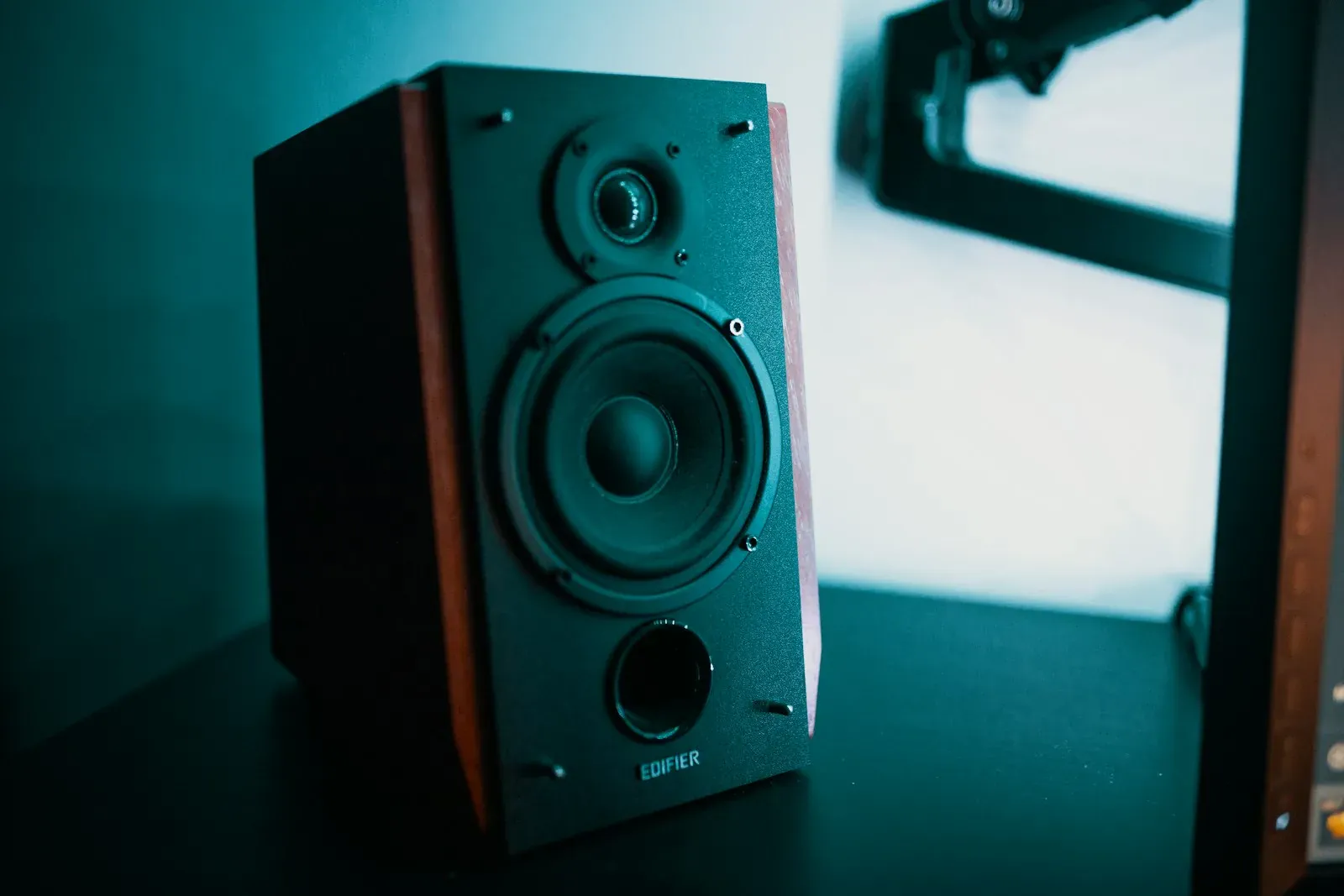
"How many watts does my amplifier need?" is the most common question we hear about amplifiers – and the number on the box answers it least of all. Here are the basics for reading data sheets and finding the right type.
Reading wattage figures correctly
A power figure is only comparable with its conditions: continuous power (RMS) rather than peak power, both channels driven simultaneously, at what impedance, over what frequency band and at what distortion (THD).
| Figure | Meaning |
|---|---|
| 2 × 80 W into 8 ohms, 20 Hz–20 kHz, 0.05% THD | honest and comparable |
| 2 × 200 W into 6 ohms, 1 kHz, 10% THD | marketing number, often under 60 W in reality |
| 1,000 W PMPO | meaningless |
A serious amplifier delivers considerably more into 4 ohms than into 8 ohms – that shows the power supply can deliver current.
Efficiency: dB per watt and metre
How loud a speaker plays with one watt at a distance of one metre is given by its sensitivity in dB/W/m. Every doubling of power brings 3 dB, every quadrupling 6 dB. A speaker with 85 dB needs four times as much power for the same level as one with 91 dB – 100 watts against 25 watts.
Impedance: 8 ohms is uncritical, 4 ohms demands current, and some speakers dip below 3 ohms in the bass. An amplifier not designed for that sounds thin, gets hot or shuts down.
Class A, AB and D
The class describes how the output stage works – not how good it sounds.
- Class A: transistors conduct all the time, very low distortion, but only 20 to 25 per cent efficiency. A niche for enthusiasts.
- Class AB: the standard of the last fifty years, around 50 to 60 per cent efficiency.
- Class D: switching amplifiers with over 90 per cent efficiency, small, cool, powerful. Modern modules (Hypex, Purifi, ICEpower) measure as cleanly as good AB stages; almost every streaming amplifier works this way today.
Integrated amplifier, pre/power, streaming amplifier
An integrated amplifier combines preamplifier (source selection, volume) and power amplifier (output) in one housing. Separate pre and power amplifiers pay off with difficult speakers, in large rooms or when the power amplifiers are to stand in the plant room.
Streaming amplifiers (WiiM, Sonos Amp, Bluesound Powernode, NAD, Cambridge Audio Evo, Naim Uniti) bring streamer, DAC, HDMI ARC and room correction in one device – by now the most common solution for the living room in our consultations.
Active speakers
In active speakers the power amplifiers sit inside the cabinet, one per driver, tuned by the manufacturer and with a DSP crossover (KEF, Dynaudio, Genelec, Kii, Buchardt). That saves the matching. The drawback: streamer and amplifier are married to the speaker, and both speakers need mains power.
What suits which speaker?
- Compact speakers, 85–87 dB, 8 ohms, living room up to 30 m²: 50 to 100 watts continuous.
- Floorstanders, 88–91 dB, 4 ohms: 80 to 150 watts into 4 ohms, power supply with reserves.
- Difficult speakers below 84 dB or with impedance minima below 3 ohms: load-stable AB or D stages.
Rule of thumb: amplifier power equal to or slightly above the speaker's rated power handling. An amplifier that is too weak is more dangerous than one that is too strong – when it clips, the tweeter dies first.
Conclusion
Read watts only with their conditions, factor in the efficiency and choose the type by room and use: streaming amplifier for the living room, pre/power for the home cinema, active speakers for desk and kitchen. In the consultation you hear the same speakers on different amplifiers; we tell you honestly where more power brings something and where it does not.
More articles
News

Soundbar or system: what the living room really needs
A soundbar is connected in ten minutes; a system with amplifier and speakers sounds better. When which solution fits – and what lies in between.

Music streaming in hi-fi quality: what you really hear
Spotify, Apple Music, Tidal, Qobuz or Amazon – the services advertise lossless and Hi-Res. What lies behind the formats, where the difference becomes audible and which route brings the music cleanly to the speaker.

Atmos, eARC, codecs, watts: sound terms explained plainly
The audio world loves abbreviations. We explain the terms that come up most often in consultations – and which of them actually count when buying.