Materials
Film types explained: cast, calendered and durability
Cast or calendered, monomeric or polymeric: the choice of film decides years of durability. An overview of types, laminates and adhesives from application practice.
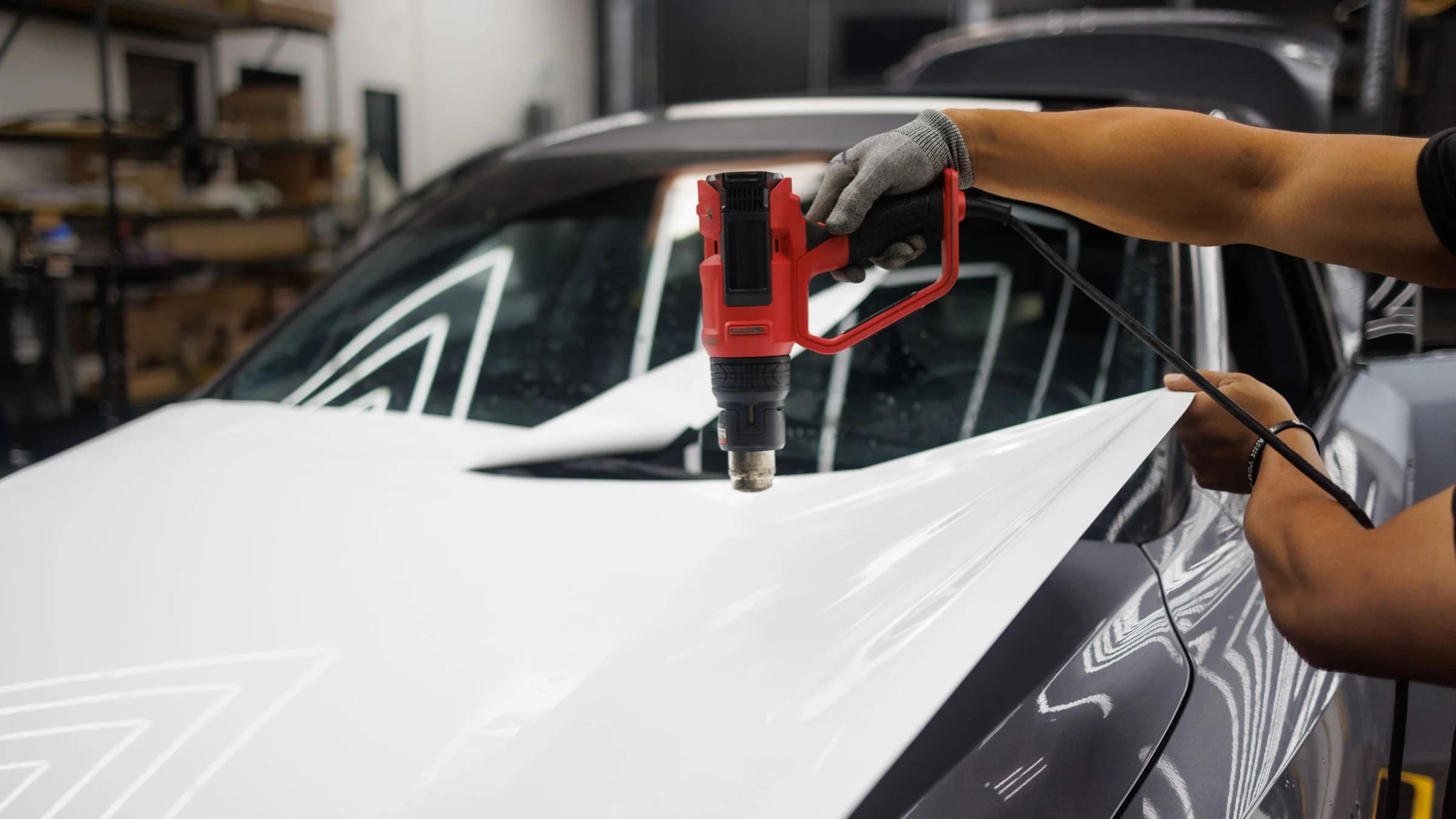
Two films can look identical on the sample and behave completely differently after two summers. The difference arises in manufacturing – and it is the most common reason why lettering gives up early.
Cast or calendered: the decisive difference
Cast film is made by pouring a liquid mass onto a carrier and drying it. It is tension-free, usually 25 to 50 micrometres thin, extremely conformable and does not pull back. Calendered film is rolled out from a mass between rollers, is 70 to 100 micrometres thick and retains internal tension. Heat and time make it shrink – at edges and in recesses that shows first.
Monomeric or polymeric
With calendered films a further distinction is made by plasticiser. Monomeric films are the simplest class: applied flat, indoors or briefly outdoors, service life roughly one to four years. Polymeric films hold the plasticiser more stably, remain more dimensionally stable and reach about five to seven years outdoors. Cast films sit at eight to twelve years.
| Type | Use | Outdoor service life |
|---|---|---|
| Monomeric calendered | flat interior surfaces, promotions | 1–4 years |
| Polymeric calendered | flat exterior surfaces, signs | 5–7 years |
| Cast | vehicles, curves, rivets | 8–12 years |
The manufacturers' figures – 3M, Avery Dennison, Orafol with the Oracal brand – apply to Central Europe and vertical surfaces. Horizontal surfaces receive more UV radiation; there the figure quickly halves.
Laminate: not cosmetics but protection
Digitally printed films need a laminate of the same class over them. It protects the ink from UV light, scratches and cleaning agents and noticeably extends the service life. Gloss looks more colour-intense, matte reflects less and is more often requested for vehicles and interiors. The pairing matters: cast print film with cast laminate, not mixed – otherwise the laminate works against the film.
Perforated, frosted and special films
- Perforated film (one-way vision) has around 40 per cent hole area: an image from outside, a view through from inside. It needs a special laminate, otherwise dirt and water settle in the holes.
- Frosted film, technically a sandblasted look, creates privacy in the office and at the same time meets the marking requirement on large glass surfaces.
- Tinting and solar control films reduce heat gain and glare.
- Fluorescent and retroreflective films are standardised for safety and signalling surfaces.
Adhesive, substrate, removability
The adhesive decides how the film behaves. Permanent adhesives are intended for lasting lettering, removable ones for promotions and rented surfaces. Adhesives with air channels – known as Comply at 3M, Easy Apply at Avery – can be applied bubble-free and corrected, which saves a lot of time on large surfaces.
The substrate must be clean, dry, grease-free and sound. Freshly painted surfaces outgas for several weeks, freshly painted walls likewise; anyone who applies too early gets bubbles. Rough render and powder-coated metals with low surface energy need a preliminary test or a primer.
And removal?
Professionally applied film can be peeled off without residue with heat and patience; a suitable remover dissolves adhesive residue. The older and thinner the film and the stronger the sun exposure, the more laborious it becomes. We record for every lettering job which film was applied – that makes removal years later plannable. Samples are ready at our place in Solothurn, happy for you to touch.
More articles
News

Solar window film: when it pays off and when it doesn’t
Too hot in the office, faded furniture, glare on the screen: a solar window film often fixes it in a day. What it does, where its limits are and what we check before fitting.
Latex, UV or eco-solvent: which printing technology for what
Three technologies share large-format printing. The difference is not in the picture but in smell, durability and material.
Sign permits: what applies before façade lettering
In Switzerland almost every façade sign needs a permit from the municipality. Anyone who knows the procedure, documents and deadlines does not lose months over it.