Advertising network
DOOH in the gym: why advertising lands where people wait
Digital Out of Home is growing because attention is where people are waiting anyway. Figures, formats and how a campaign is built.
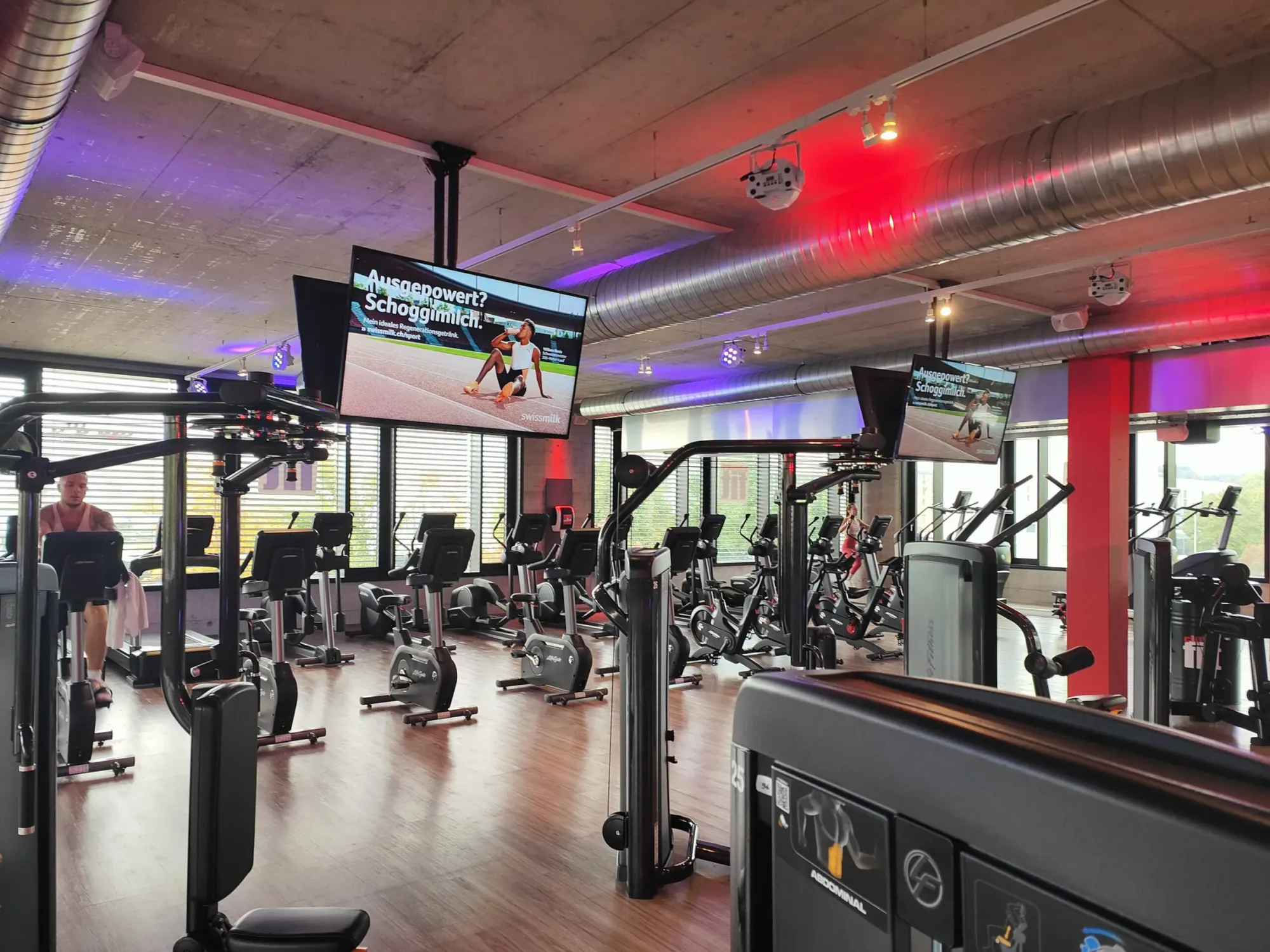
Digital Out of Home – DOOH for short – is the only classic form of advertising that has grown in the past ten years while print and linear television have lost. The reason is banal: the screen hangs where people are standing anyway with nothing to do.
Why gyms work particularly well
In the gym dwell time is long, visit frequency regular and the mood positive. Anyone pausing between two sets looks around. That is exactly when the spot runs. We operate a network with over 5,000 advertising surfaces at more than 1,000 locations – a large share of them in fitness and leisure facilities across Switzerland.
Add the audience: health-conscious, affluent, locally rooted. For a bicycle dealer, a physiotherapy practice or a restaurant in the same town that is a precise channel.
What a spot has to deliver
A DOOH spot is not a TV commercial. It runs without sound, lasts between seven and ten seconds and is seen from several metres away. What works:
- One statement, not three.
- Large type, high contrast, little text.
- Brand at the beginning and the end, not only at the end.
- A clear next step: place, QR code or search term.
What it costs and what you get for it
A regional campaign in the network is well affordable for a local business; nationwide coverage is considerably higher. What matters is not the price per screen but the price per contact opportunity – and there DOOH is regularly below print and radio.
We deliver the evaluation with it: locations, run times, plays. That allows a campaign to be sharpened next time instead of repeated.
How a campaign is built
A booking in the network runs in weekly steps. The spot is played at defined locations in rotation, typically several times an hour. Anyone advertising regionally chooses locations within a radius of twenty to thirty kilometres. Anyone going national books location groups by canton or gym chain.
A run time of at least four weeks makes sense. Two weeks are not enough for the recognition effect; more than eight weeks without a change of creative leads to fatigue. We therefore recommend two creatives in alternation.
Design: the hard school
The biggest difference from print is distance. A poster is read from two metres, a DOOH spot from five to eight. Rule of thumb: type size at least one twentieth of the picture height, at most seven words per frame, no thin weights, no text on busy backgrounds.
Movement helps, but sparingly. A picture change every two seconds looks nervous. A calm camera move or a single transition is enough.
What is measurable – and what is not
DOOH delivers play counts, locations and run times. What it does not deliver is a click. Anyone who wants to measure the effect needs a second marker: a dedicated discount code, a landing page with its own address or simply the question at the point of sale where someone comes from.
For a gym operator advertising in their own gym the measurement is simpler: sign-ups for a course promoted only on the screen. We run such tests with clients regularly before larger budgets flow.
More articles
News
Ten years of digital signage: what has really changed
Screens have become cheaper, content more demanding and operation more important than the hardware. A retrospective from installation practice.
Digital signage in the shop window: how bright does the display have to be?
Sun, reflections and heat behind glass decide whether a shop window display works. What nits mean, which values are enough and what matters for film, power and operating hours.

Waiting room TV: what patients really want to see
A screen in the waiting room can inform or annoy. Which content lands, whether sound makes sense, what data protection demands for patient calls and how practice, pharmacy and municipality benefit.